Table of Contents
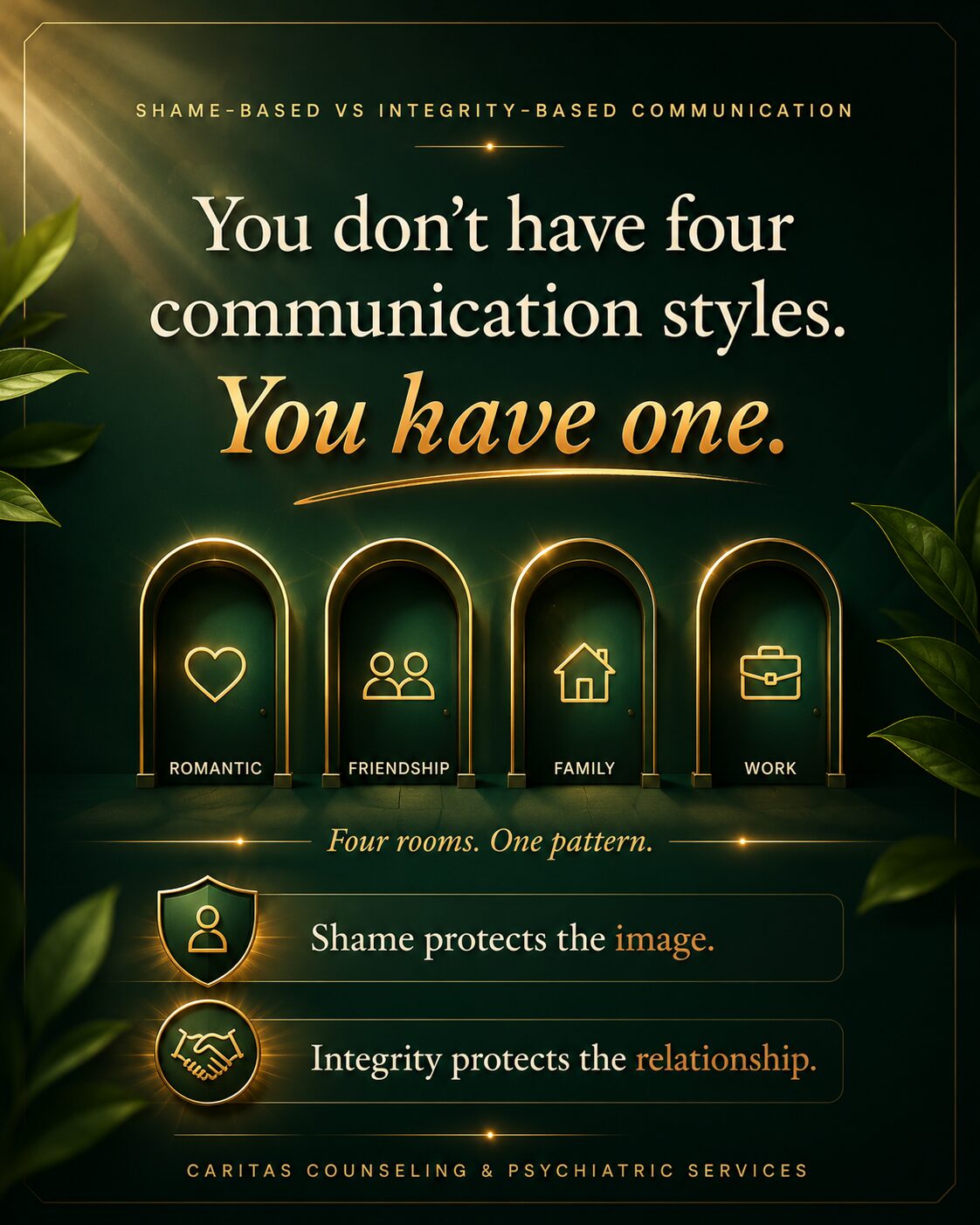
You do not have a communication style for your marriage, a different one for your friendships, another for your family, and a fourth for your job. You have one. It travels with you into every room you enter, because it does not live in the relationship. It lives in you.
This is why the same person who deflects feedback at work also gets defensive with their spouse. Why the friend who ghosts when things get uncomfortable also goes silent with their siblings. The setting changes. The pattern does not.
Most communication patterns fall somewhere on a spectrum between two orientations: shame-based and integrity-based. Understanding which one is running your relationships, and why, is one of the highest-leverage pieces of self-knowledge you can acquire.
What Shame-Based Communication Looks Like
Shame-based communication is organized around one goal: protecting the self from exposure. When shame runs the system, the unconscious priority in every hard conversation is not connection, resolution, or truth. It is escaping the unbearable feeling of being seen as bad, wrong, inadequate, or unlovable.
The behaviors look different on the surface, but they share the same engine:
- Defensiveness. Every piece of feedback is treated as an accusation. The response to “that hurt me” is “well, you do it too,” or “that’s not what happened,” or “you’re too sensitive.”
- Blame-shifting. Responsibility is a hot potato. If I am at fault, I am bad, so the fault must belong to someone else.
- Stonewalling and withdrawal. Shutting down, going silent, leaving the room, disappearing for days. If I cannot be reached, I cannot be exposed.
- Attacking and contempt. Criticism of the other person’s character, mockery, eye-rolling, sarcasm with an edge. The best defense against being made small is making the other person smaller first.
- Image management over honesty. Lying, minimizing, hiding, spinning. The relationship gets a curated version of you, because the real version feels too dangerous to show.
- Apologies that are not apologies. “I’m sorry you feel that way.” “I’m sorry, but you have to understand…” The words appear, but accountability never lands.
- Keeping score. Old offenses are stored as ammunition, because in a shame economy, the person with the most grievances holds the moral high ground.
- Rewriting history. Denying what was said, insisting the other person is remembering wrong, reshaping events so that the self stays innocent.
Notice what all of these have in common. None of them are about the actual issue on the table. They are all about managing an internal emergency: the felt threat of being defective.
What Integrity-Based Communication Looks Like
Integrity-based communication is organized around a different goal: staying whole and staying connected at the same time. The word integrity comes from the same root as integrated. It means the inside and the outside match. What I feel, what I say, and what I do line up, even when that is uncomfortable.
- Non-defensive listening. Feedback is information, not indictment. “Tell me more about that” is possible because hearing “I did something hurtful” does not collapse into “I am something hurtful.”
- Owning your part. “You’re right, I did that, and I can see how it landed.” Not the whole conflict, not more than your share, but your actual part, named plainly.
- Staying in the room. Remaining present in hard conversations, or naming the need for a pause honestly: “I’m flooded and I need twenty minutes, and I will come back.” Withdrawal with a return time is regulation. Withdrawal without one is punishment.
- Direct requests instead of tests. Saying “I need more time with you” instead of picking a fight to see if the other person will chase you.
- Clean apologies. Naming the harm, expressing genuine remorse, and changing the behavior. No “but.” No redirect.
- Boundaries stated without cruelty. “I’m not able to do that” delivered as information, not as a weapon or a guilt trip.
- Repair-seeking. Treating rupture as normal and repair as the skill. Integrity-based communicators are not people who never cause harm. They are people who move toward the mess instead of away from it.
- Truth-telling with kindness. Honesty that serves the relationship, not honesty used as a bludgeon and labeled authenticity.
The difference is not politeness. Shame-based communicators can be exquisitely polite. The difference is what the communication is protecting: the image, or the relationship.
The Same Pattern, Four Different Rooms
Because the pattern is internal, it shows up wherever the person goes. Here is what each orientation looks like across the four major arenas of life.
Romantic
Shame-based: Your partner says, “I felt alone at the party last night.” You hear an accusation that you are a bad partner, and the shame flares. So you counter: “Alone? I introduced you to everyone. Maybe if you made more of an effort you wouldn’t feel alone.” The evening is now about defending your adequacy. Your partner’s loneliness never gets addressed, and now they are also managing your reaction. They learn to stop bringing things up.
Integrity-based: Same sentence from your partner. You feel the sting, notice it, and stay. “That’s hard to hear, and I want to understand it. What was happening for you?” Later: “I think I got caught up in the crowd and lost track of you. I’m sorry. Next time, let’s check in halfway through.” The issue got smaller. The trust got bigger.
Friendship
Shame-based: A friend gently tells you that you have canceled plans four times in a row. Shame says you are a bad friend, and that verdict is intolerable, so you deflect: “I’ve been slammed, you know how my job is. Honestly, you cancel too.” Or you swing the other way and collapse into self-flagellation: “I’m the worst, I ruin everything, you should just find better friends.” Both moves put your friend in the position of either backing down or comforting you. Either way, their original concern evaporates.
Integrity-based: “You’re right, I have, and that’s not the friend I want to be to you. I’ve been overwhelmed and I let this slide. Can we put something on the calendar right now, and I’ll protect it.” The friend feels valued. The friendship gets stronger precisely because it survived a hard truth.
Family
Shame-based: An adult child tells a parent, “When you comment on my parenting in front of the kids, it undermines me.” The parent, flooded with the shame of being cast as a bad parent themselves, retaliates: “After everything I’ve done for you, this is what I get? Fine, I just won’t say anything ever again.” The conversation is now about the parent’s wounded image. The adult child learns the price of honesty and stops paying it. Distance grows and gets mislabeled as busyness.
Integrity-based: “I didn’t realize I was doing that, and I can see why it bothers you. I’ll save my thoughts for when the kids aren’t around, and honestly, I’ll work on offering fewer of them unless you ask.” One sentence of ownership does more for closeness than twenty years of holiday dinners.
Work
Shame-based: A manager gets feedback that their team feels micromanaged. The shame of being seen as a bad leader is intolerable, so the data must be wrong: “They just don’t like accountability. This is a performance culture, and some people can’t handle it.” Or the shame turns on the messenger, and the employee who spoke up finds themselves quietly frozen out. The team learns that honesty is punished, and the manager now leads a group of people who tell them only what is safe.
Integrity-based: “That’s uncomfortable to hear, and I’m glad you told me. Help me understand where it shows up most.” The manager may not agree with every detail, but they treat the feedback as a map instead of an attack. Psychological safety is not a poster in the break room. It is a leader metabolizing criticism without retaliating.
Read those eight examples again and notice something: the shame-based responses came from four different relationships, but they are the same move. Protect the self, abandon the issue, and make the other person’s honesty expensive. The integrity-based responses are also one move: feel the sting, stay present, own your part, repair. Four rooms. One pattern. One person.
Where Shame-Based Patterns Come From
No one chooses shame-based communication. It is learned, and it is learned early, usually in environments where being wrong was dangerous.
Shame and guilt are not the same thing. Guilt says, “I did something bad.” Shame says, “I am something bad.” Guilt is about behavior, which can be repaired. Shame is about identity, which feels unrepairable. A child who is corrected with guilt learns that mistakes can be fixed. A child who is corrected with shame learns that mistakes are evidence.
If your caregivers responded to your errors with rage, ridicule, withdrawal of affection, or comparison to a better sibling, your nervous system drew the obvious conclusion: exposure equals danger. Being wrong does not lead to teaching. It leads to abandonment, humiliation, or attack. So you built armor. Defensiveness, blame, hiding, attacking first, disappearing. Those were not character flaws. They were survival strategies, and at the time, they worked.
The same lesson gets installed in homes where love was conditional on performance, where one parent’s emotions ran the house and everyone else managed them, where problems were denied rather than discussed, or where accountability only flowed downhill. In each version, the child learns the same core belief: the real me, the flawed me, cannot be seen and still be loved.
Attachment research gives this a vocabulary. Anxious strategies chase reassurance to quiet the shame. Avoidant strategies wall off connection so the shame can never be triggered. Both are shame management systems wearing different costumes, and both trade authenticity for safety. Secure connection sits in a different place entirely: the lived experience that I can be fully known, including my failures, and remain loved. Most shame-based communicators have simply never had that experience long enough to trust it.
Here is the compassionate truth and the hard truth in one sentence: your shame-based patterns are not your fault, and they are your responsibility. You did not install the armor. But you are the only one who can take it off.
Healing: Growing From Shame Into Integrity
Healing does not mean eliminating shame. Shame is a human emotion, and it will visit you for the rest of your life. Healing means shame stops being the manager of your relationships. The path runs through three movements: awareness, accountability, and attunement. Seeing, doing, and being.
Awareness is seeing the pattern in real time. Shame moves fast, usually faster than thought. The flush of heat, the tight chest, the surge to defend or disappear. The first skill is simply catching it: “There it is. That’s shame, not truth.” Naming the state creates a half-second of space between the trigger and the armor, and that half-second is where every other change lives. Start by reviewing conversations after the fact. What did I feel right before I got defensive? What was I protecting? Over time, the review moves closer to the moment, until eventually you can catch the wave as it rises.
Accountability is doing something different once you see it. Awareness without action is just well-narrated repetition. Accountability means choosing the integrity move while the shame is still burning: staying in the room when everything in you wants to leave, saying “you’re right, I did that” when your whole body is drafting a rebuttal, offering a clean apology with no “but” attached. It will feel wrong at first. That is not a sign you are doing it badly. That is the feeling of acting against decades of armor. Accountability also means repair. When you catch yourself a day late, you go back: “Yesterday when you brought that up, I got defensive. You deserved better. Can we try again?” Late repair is still repair, and it teaches your nervous system the lesson it never got: exposure did not end in abandonment.
Attunement is being with yourself and others differently. This is the deepest layer, because shame-based communication is ultimately a relationship problem with yourself before it is a relationship problem with anyone else. The voice that attacks you when you fail is the same voice you defend against when your partner raises a concern. Learning to meet your own mistakes with firmness and compassion, the way a good parent meets a child’s mistakes, gradually drains the terror out of being wrong. When “I made a mistake” no longer threatens “I am a mistake,” you no longer need the armor. Feedback becomes survivable, then useful, then welcome. For many people, this layer of work goes best with a therapist, because shame formed inside relationships and it heals inside relationships. Corrective experience, not just insight, is what rewires it.
Why This Is the Best Return on Investment You Will Ever Get
Here is the part most people miss, and it is the reason this work matters more than almost any other self-improvement project you could choose.
Because the pattern is internal, you cannot heal it in one relationship and leave it broken in the others. And you do not have to. When you do the work once, in you, the dividend pays out everywhere at the same time.
The person who learns to hear their partner’s hurt without collapsing into defensiveness is the same person who can now receive their manager’s feedback, their friend’s honesty, and their mother’s criticism. The person who learns to give a clean apology gives it in every room. You are not fixing four relationships. You are fixing one nervous system that shows up in four places.
Compare that to every other investment you could make. A new job improves one domain. A new city changes your scenery and ships your patterns in the moving truck. But healing your interpersonal patterns upgrades every relationship you currently have and every relationship you will ever have, including the one with yourself, and including the ones your children are learning by watching you. Shame-based communication is generational until someone metabolizes it. Integrity-based communication is generational too.
That is the whole case. The pattern is internal, so the healing is portable. Do the work once, in you, and every room you walk into for the rest of your life gets the benefit.
The armor made sense once. You needed it. But you are not in that house anymore, and the people in front of you now are not the people who taught you to hide. You are allowed to be seen. And the relationships waiting on the other side of that risk are the ones the armor was never able to give you.