Table of Contents
May is Women’s Health Month, a time to take stock of how we are doing. Not just physically, but psychologically. Relationally. Honestly.
I work with women every day who are exhausted, resentful, depleted, and genuinely confused about why their relationships keep producing the same outcomes. They are not weak women. They are often extraordinarily capable, emotionally intelligent, and self-aware in many areas of their lives. And they are stuck in patterns they haven’t fully examined, patterns that the content ecosystems they inhabit are quietly reinforcing rather than interrupting.
The Meme We Keep Sharing
There is a man in a pink princess dress and a tiara, holding a Stanley cup. Floating around him are quotes: “I don’t chase, I let women prove themselves to me.” “What do you have planned for us this weekend?” “Can we split the bill?” “I will pay you back.” “I borrowed your concealer.”
The meme is funny. I have scrolled past it and smiled too. It catalogs real frustrations, men who won’t plan, won’t initiate, who take without reciprocating. The anger underneath it is legitimate.
But sit with the image itself for a moment. The man’s failures are illustrated with a dress. A tiara. A Stanley cup. The visual language of femininity is the punchline. His bad behavior is funny because he looks like a woman, which means the joke only works if femininity is the insult.
A woman scrolling this and laughing is, without realizing it, laughing at herself. The dress she might own. The tiara from her bachelorette. We share it because the frustration feels true, without pausing on what the imagery is actually saying about us.
Dissociating Barbie, Hostile Barbie, and What Gets Installed
Spend enough time in the female corners of social media and a few archetypes emerge.
There is dissociating Barbie, smiling when she would rather not, performing pleasantness while internally elsewhere. The narrative frames this as something being done to her. She has no choice. It presents self-abandonment as an inevitability of womanhood rather than a pattern with a history, and never asks: why does she keep choosing this, and what would it take to choose differently?
Then there is hostile Barbie. Men reduced to spam mail. Evaluated, found insufficient, deleted. The humor is sharp and sometimes genuinely funny. But humor is one of the most effective vehicles for belief installation, we laugh, we share, we absorb. With repeated exposure, this content builds a framework in which men are objects to be managed or discarded, and the primary relational posture toward them is defensive contempt.
None of this content created the frustration underneath it. That frustration is real. But it validates and amplifies without offering any path through. It is not healing content. It is venting content depicted as wisdom. And for Women’s Health Month, that distinction matters, because venting without direction is not the same as healing, and our psychological health depends on knowing the difference.
When we consume content that frames men as inherently toxic and relationally dangerous, we don’t become more discerning. We become more primed. Our nervous systems, trained by lived experience and repeated media exposure, are very good at finding confirmation of what we already believe. The content shaping our lens is also shaping what we see through it.
The first pillar of the Caritas Aligned™ Framework is Awareness — the capacity to see what is actually happening, without defense or collapse. That includes seeing ourselves. Not just what he did, or what the relationship produced, but our own role in the pattern. Not as self-blame, but as radical honesty that puts agency back in our hands.
The Empathy That Costs You
Too often women are socialized, rewarded, really, for emotional attunement to others. For anticipating needs, being empathetic, absorbing discomfort. Many of us became excellent at this very early because we had to be. It kept the peace. It earned love, or at least approval.
But there is a version of empathy that is not healthy attunement. It is empathy without reciprocity. Extended so habitually and so far beyond what is returned that it becomes self-abondoment. We feel deeply with and for others, and in the process, lose contact with our own interior experience. When that empathy is not reciprocated, we feel it: a slow accumulation of resentment, a creeping depletion, a sense of giving from an account that is never replenished. And instead of tracing that feeling back to the asymmetry we have been participating in, we often turn it into a story about what is wrong with him, or men, or relationships as a category. The womensphere content is waiting for us at exactly that moment.
True Attunement — the third pillar of the Caritas Aligned™ Framework — is not simply tuning in to others. It is the capacity to receive and give love in ways that are regulated, present, and mutual. Attunement that only flows outward is not attunement. It is depletion with good intentions.
If you are exhausted from carrying all of the emotional labor, that is important information. The question worth sitting with is not only “why won’t he do his share?” but also: when did I begin doing his share, and why did I keep doing it? What was I afraid would happen if I stopped? Those questions are not comfortable. They are also where your actual power lives.
Communication, Boundaries, and the Follow-Through
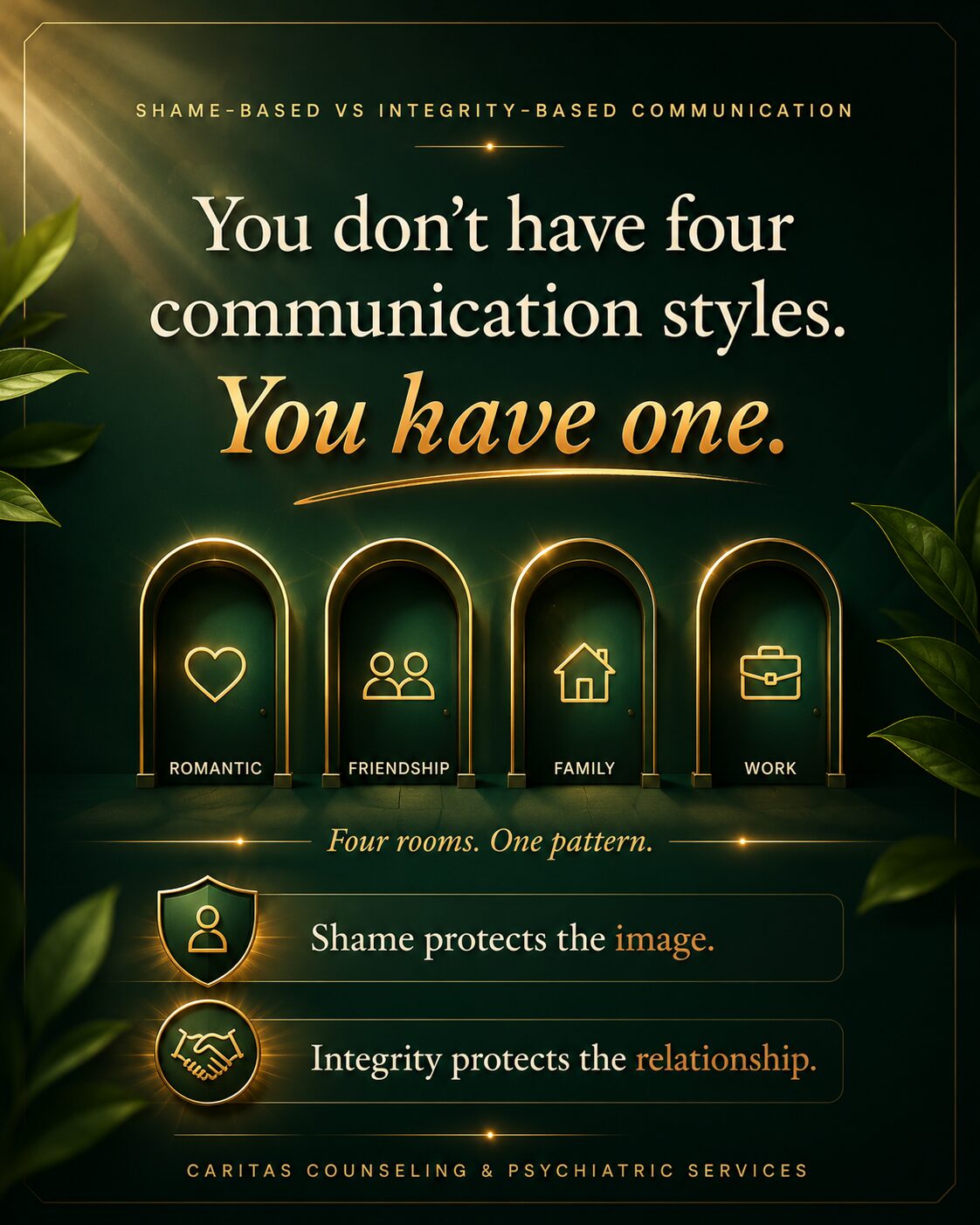
One of the quieter costs of these patterns is what happens to communication. When we have learned that our needs are too much, or that expressing them directly leads to conflict, we adapt. We hint. We over-explain. We soften until the message disappears. Or we go silent and build up until it comes out carrying months of unexpressed experience, with a force that feels disproportionate, because it is.
Healthy communication is direct without being weaponized. It names what is happening internally without assigning blame for the internal state. “I notice I’m feeling overlooked when plans consistently fall on me” lands differently than “You never plan anything.” Both might be true. Only one opens a door. This is not about being softer. It is about being clearer, and recognizing that communication designed to be heard and communication designed to wound are not the same thing.
Boundaries live in the same territory. The word has been diluted by wellness culture until it can mean almost anything. A genuine boundary is not about controlling another person. It is a clear statement of what you will and will not participate in, grounded in your values and your knowledge of what you need to remain psychologically intact. And the Accountability pillar of the Caritas Aligned™ Framework is what gives a boundary its integrity , because a boundary you state once and don’t maintain is not a boundary. It is an announcement. The follow-through is what makes it real, and that follow-through is often uncomfortable for women who have been socialized to prioritize relational harmony above their own limits.
If you are with a partner who consistently pushes physical or emotional limits, who treats your stated needs as invitations to negotiate, he is showing you something real. That information is available at sign one. Leave at the first sign. Not the tenth. Not after years of investment in someone who showed you clearly, from the beginning, how he relates to your limits.
This Women’s Health Month
There is an entire industry of support for women built, subtly or explicitly, around managing men. Understanding his attachment style so you can work around it. Translating yourself into terms he’ll receive. How to stay, how to cope, how to endure.
I want to offer a different orientation: invest in yourself.
Not as a strategy to attract or retain a partner. As a genuine commitment to your own psychological health and your own capacity for the relationship you actually want. In practical terms: developing the Awareness to recognize your own emotional states clearly enough to respond rather than perform. Building the Accountability to examine your patterns honestly, what you bring into relational dynamics and what you are willing to change. Cultivating the Attunement to receive care as readily as you extend it, to let yourself be known rather than only knowing others.
Your psychological health, which Women’s Health Month is also about, even when it goes unspoken, depends on more than venting. It depends on turning Awareness toward yourself with the same honesty you turn toward the men who have disappointed you. On Accountability that is not self-punishment but self-authorship. On Attunement that begins with you: knowing what you feel, what you need, and what you are worth, without needing another person to confirm it first.
That is not armor. That is foundation.
And a relationship built on that foundation, between two people who are both doing this work, is not a fantasy. It is what Caritas Aligned love actually looks like.
You deserve that. Not someday. Now.