Why you feel exhausted, reactive, and quick to apologize, and what your body is actually trying to do.
By Stacey Lambour, DNP, PMHNP-BC
You are tired in a way that rest does not seem to fix.
Maybe you are the one who gives until there is nothing left, who explains and re-explains so no one will be upset with you, who feels a knot of guilt the moment you say no. Maybe you went quiet a long time ago, because conflict stopped feeling safe, so now you either shut the door or you brace for impact. Or maybe you are sure you are the steady one in your relationships, the one who has done the work, and you came here mostly to understand why everyone around you is so difficult.
Those are three of the most common ways people move through their relationships, and you probably recognize yourself in one of them and the people you love in the others. The pattern underneath all three is the same. What we call personality is very often the nervous system doing the only thing it ever learned to do to keep us safe.
That is the most hopeful sentence I know how to write. A personality feels fixed. A pattern can be changed.
The patterns most people never get to see
When I sit with someone who is worn down by their relationships, the same handful of patterns show up again and again. Not character flaws. Not proof that they are too much or not enough. Just old survival strategies that worked once and overstayed their welcome. See if any of these are yours.
The emotional exhaustion. You are not lazy and you are not weak. You are running a background program that scans every room for whose mood you need to manage. That kind of vigilance burns the same fuel whether anyone notices or not, and at the end of the day there is nothing left for you.
The reactivity you cannot quite control. A tone of voice, a left-on-read, a closed door, and suddenly your heart is pounding and your story is racing ahead of the facts. That is not you being dramatic. That is a nervous system that learned, early, that small signals meant real danger. The body remembers what the mind has forgiven.
The overexplaining. You send the paragraph, then the second paragraph, then the apology for the length of the paragraph. Underneath it is a quiet belief that your no, your need, your simple yes is not allowed to stand on its own, that you have to earn the right to take up space by justifying it.
The guilt when you set a boundary. You finally say the honest thing, and instead of relief you feel like you did something cruel. That guilt is not a moral signal. It is the alarm of a child who learned that love could be withdrawn, firing in the body of an adult who is only asking to be treated well.
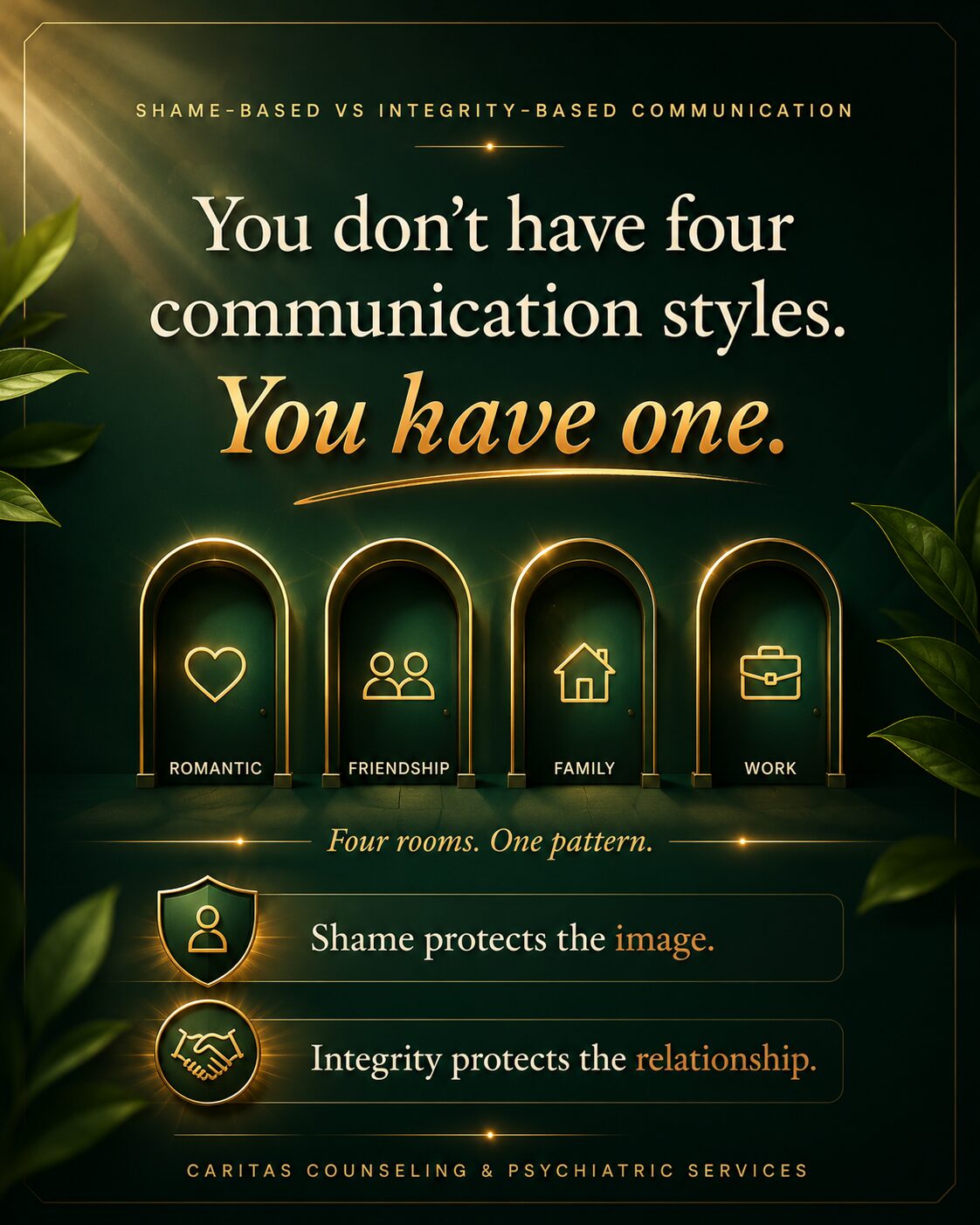
The reactivity or the avoidance when conflict comes. Some of us flood. We get loud, we get fast, we have to be understood right now. Some of us vanish. We go cold and efficient and unreachable. These look like opposites, and they are the same root. Both are what a body does when staying open in a hard moment feels like it might cost you everything.
And then the void. This is the one almost no one warns you about. You start to heal, you stop running the old pattern, and instead of peace you feel a strange emptiness. The performing, the managing, the bracing took up so much room that when they quiet down, there is a hollow where they used to be. That void is not a sign you are doing it wrong. It is the space your real self is being invited to grow into.
If you saw yourself in even one or two of those, I want you to hear the thing I tell every person in my office. None of this means you are broken. It means you adapted. And what was learned in relationship can be healed in relationship, starting with the one you have with yourself.
You learned these, which means you can learn your way out
There is a popular idea I want to push back on, because I watch it keep people stuck.
There is a very loud message out there saying that you, or someone you keep struggling with, has a fixed pattern, and that this is simply who that person is. It arrives as a tidy label. An anxious type, an avoidant type, a narcissist, a certain attachment style, a permanent setting. The label sounds like insight, and it feels like relief for about a week, because a name for the pain is better than no name at all. But putting a label on a pattern is not the same as understanding it, and it is not the same as staying in connection with the person who carries it. “This is just how I am,” or “this is just how they are,” is one of the most expensive sentences a person can believe, because it quietly closes the door on the very change that would set everyone free.
You were not born overexplaining. No infant came into the world bracing for conflict or feeling guilty about a boundary. These are patterns you absorbed, mostly before you had words, from the relationships that taught you what love seemed to require. Patterns are learned. And anything learned can be unlearned and replaced with something truer. That is not a slogan. That is how the nervous system actually works.
A way through: Awareness, Accountability, Attunement
In my practice I call this the Caritas Aligned framework, and it rests on three movements. They are simple to name and a lifetime to practice, which is exactly the point.
Awareness comes first, and it is gentler than you think. You are not trying to fix anything yet. You are only learning to catch the pattern as it happens, to feel the heat rise before the words come out, to notice the apology forming before you have done anything wrong. Awareness is the first time you get to see the program running instead of just being run by it.
Accountability is the part everyone braces for, and I want to take the sting out of it. Accountability is not blame. You are not responsible for the wound that taught you this. You are not at fault for what happened to you as a child. You are simply the one person with the power to tend it now. Owning your part is not punishment. It is the moment you stop waiting for someone else to come and undo what was done, and you pick up the authorship of your own life.
Attunement is the homecoming. It is learning to turn toward the frightened part of you with the steadiness you always wished someone had offered you, so that you can stay present in the hard moment instead of flooding or fleeing. Attunement to yourself is what finally makes real attunement to another person possible. You cannot offer a regulated presence you have never received, and the beautiful secret is that you can learn to give it to yourself first.
This is what I mean when I say love is not only a feeling. Love is a practiced discipline. It is something you build, one regulated moment at a time, in the place where the old pattern used to live.
A word for the in-between
If you are in that void right now, the strange empty stretch after the old self has loosened its grip and before the new self has fully arrived, please do not read the emptiness as failure.
Often the void is exactly this. You have left the old patterns behind, but you have not yet seen the fruit of the new ones in your actual life. Sometimes that means you have started to step back from relationships that ran on the old dynamic, and you have not yet grown a circle of the healthier ones to take their place. So for a season you can feel more alone, not less, even though you are doing everything right. That is a normal part of the transition, not a sign you made a mistake. The new relationships, the new ease, the new steadiness in your own body, these are real, and they take time to grow. Fruit always does.
Healing is rarely a straight climb. It is more like a spiral. You will meet the same pattern again at a deeper level, and some days the old reactivity will come roaring back as if you learned nothing, and that is not a relapse. That is the work. The goal was never to become a person who never gets activated. The goal is to become a person who notices sooner, recovers faster, and treats oneself with mercy in the meantime.
You do not have to have it all healed before you are allowed to like yourself. The mercy is available to you in the middle of the mess, not as a reward at the end of it.
The misinformation that feels good
None of this is only personal. We have built a system that keeps these patterns running, and we have done it to ourselves and to each other.
Your nervous system reactivity is not just a private wound. We live inside a world that is engineered to keep us hypervigilant. The news and social media feed is curated to make our heart rate spike, because a spiked heart rate keeps us scrolling. And the loudest voices in that world aren’t usually the ones helping us repair. They are the ones handing out the comfortable misinformation, the kind that feels good in the moment and quietly leaves us worse off. The narrative that confirms everyone else is the problem. The label that lets us off the hook. The reassurance that we are the healthy one and they are the broken one.
There is something strange about this moment. We have taught our machines to be patient, to answer kindly, to stay calm under pressure. And at the same time, we have trained ourselves in the opposite direction, rewarding the pile-on and the performance of certainty over the slow, unglamorous work of staying in connection with another human being.
You will not heal these patterns by taking in more of the content that profits from keeping you reactive. You heal by stepping out of the eco chamber long enough to come home to your own body, your own breath, your own worth, anchored in something steadier than the next notification.
What this is really about
You did not choose these patterns. You inherited them, absorbed them, survived with them. That is not your shame to carry.
But you are the one who gets to choose what happens now. You can learn to feel the heat and not strike. You can let your no stand without the three paragraphs after it. You can set the boundary and let the guilt be just weather passing through, not a verdict. You can stay in the room when it is hard, or leave it with a clear and quiet heart.
That is not your personality changing. That is you, no longer run by the parts of you that were only ever trying to keep you safe.
You are not too much. You were never too much. You are a person learning, maybe for the first time, what it feels like to be safe in your own company. And that is the most important relationship you will ever tend.
If you are in a relationship that is not physically or emotionally safe, please prioritize your safety. Inner work and protecting yourself are never opposites, and you do not have to finish the healing before you are allowed to step away.