Table of Contents
- 1 🌸 Control Often Begins Quietly
- 2 🌼 Emotional Manipulation as Learned Survival
- 3 🌻 The Escalation of Boundary Testing
- 4 🌷 Discernment: Seeing Without Blaming
- 5 🌼 Boundaries as Healing, Not Punishment
- 6 🌺 Context Matters: Power, Culture, and Systems
- 7 🌻 When Fear of Loss Keeps Control Alive
- 8 🌿 The Path From Control to Conscious Love
- 9 💗 Caritas Practices for Emotional Safety
- 10 🌸 Hope and Repair
In recognition of Domestic Violence Awareness Month, this reflection explores how subtle forms of control—emotional, relational, and psychological—can appear in all types of relationships. It examines how these patterns quietly erode safety and trust, and how conscious love, self-awareness, and boundaries rooted in Caritas can begin to restore freedom, dignity, and compassion.
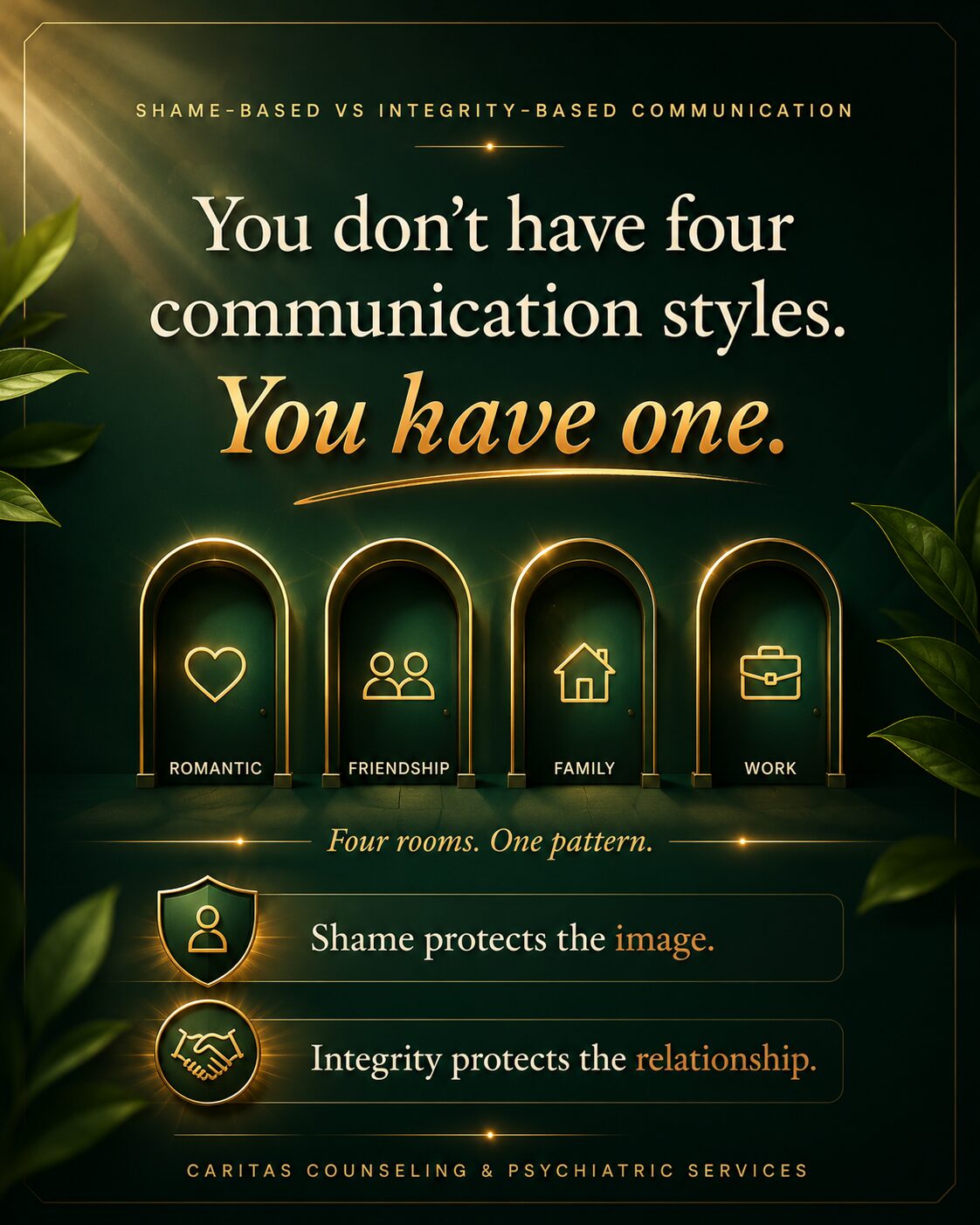
In many relationships—romantic, professional, familial, or communal—control rarely begins with shouting or obvious abuse. It starts quietly, through subtle emotional manipulation, guilt, charm, or avoidance that slowly reshapes safety and trust. Most of us were conditioned to survive connection this way: one person controls to avoid loss, the other appeases to preserve peace.
This article explores how those patterns form, why they intensify over time, and how awareness, accountability, and boundaries rooted in Caritas—love made conscious—can restore emotional safety and freedom for both people.
Healthy relationships grow in the soil of trust, respect, and emotional freedom.
But not every relationship begins there. Many start warmly—full of charm, generosity, or deep connection—only to shift gradually into tension, confusion, and control.
Control-based relationships seldom start with open dominance. They begin with conditioning—the emotional habits we learned long before we met each other.
Most of us were not taught how to name needs, express limits, or manage anxiety directly.
Instead, we learned to protect connection through appeasement, pressure, or emotional withdrawal—strategies that once kept us safe but now make love unsafe.
Recognizing these dynamics early isn’t about blame. It’s about awakening to how fear distorts love and how awareness, accountability, and compassion can restore it.
🌸 Control Often Begins Quietly
Control rarely enters a relationship loudly. It starts in subtle ways that test boundaries and reshape safety:
A friend who offers “advice” that feels more like correction.
A boss who uses guilt to inspire compliance.
A parent who withholds affection until you agree.
A partner who teases your sensitivity under the guise of humor.
These patterns are often learned defenses, not deliberate cruelty. One person may control to avoid abandonment; another may appease to preserve peace. Both are seeking safety through familiar, unconscious habits.
Yet it is vital to state clearly: no one is ever responsible for another person’s abusive or coercive behavior.
Understanding the roots of control does not excuse it. Compassion explains why something happens; accountability determines what must change.
🌼 Emotional Manipulation as Learned Survival
Subtle manipulation is often learned early, when direct expression once led to rejection or punishment.
The nervous system adapts by replacing authenticity with strategies:
Charm instead of honesty
Guilt instead of vulnerability
Withdrawal instead of dialogue
Caretaking instead of self-expression
These behaviors may keep peace temporarily, but over time they erode trust.
What began as self-protection becomes control.
What once felt like care becomes coercion.
When Manipulation Is Conscious
While much manipulation arises unconsciously from fear, some is intentional—designed to maintain power or advantage. Recognizing this distinction is essential.
Victims are never at fault. Awareness is not an invitation to tolerate deliberate harm but a tool to recognize it early and step away safely.
🌻 The Escalation of Boundary Testing
Unchecked boundary testing follows a predictable arc:
Minimization – “It was just a joke.”
Dismissal – “You’re overreacting.”
Justification – “I only said that because I care.”
Withdrawal or Punishment – Silence, coldness, or moral superiority when challenged.
As these moments accumulate, the relationship becomes emotionally dysregulated.
One person feels increasingly powerless; the other increasingly entitled.
Without intervention, the system begins to mirror early trauma: love mixed with fear, intimacy tied to compliance.
🌷 Discernment: Seeing Without Blaming
Discernment is the capacity to see clearly without condemning blindly.
It acknowledges that two truths can coexist:
Both people may bring conditioned survival strategies.
Only the person using coercion is responsible for the harm it causes.
Awareness helps us separate understanding from accountability.
We can hold compassion for how fear formed these patterns while insisting that love never justifies control.
🌼 Boundaries as Healing, Not Punishment
Boundaries are not rules for others; they are responsibilities we take for ourselves.
Control tries to change another person’s behavior.
Boundaries clarify our own: what we will allow, what we will engage in, and what we must release.
Two Essential Boundary Skills
1. Containment
Holding our own emotions without projecting them onto others.
“I notice I feel anxious when you don’t respond quickly. I’ll take a moment to calm myself before assuming the worst.”
Containment transforms reactivity into reflection.
2. Assertion
Expressing needs and limits clearly, even when it risks discomfort.
“I value this relationship, and I need conversations to remain respectful for me to stay engaged.”
Assertion replaces appeasement with authenticity.
For those still recovering from trauma bonds, even this can feel unsafe. In those cases, the first boundary is internal:
“I will begin noticing what feels wrong, even if I can’t speak it yet.”
Awareness is the seed from which safety grows.
🌺 Context Matters: Power, Culture, and Systems
Control doesn’t exist only in individuals; it’s reinforced by systems—families, workplaces, faith communities, and cultures that equate obedience with virtue and dissent with disloyalty.
Recognizing these influences protects us from internalizing blame for dynamics that were normalized long before we could choose differently.
Healing therefore requires both personal accountability and collective awareness—learning to create environments where truth is not punished and boundaries are respected.
🌻 When Fear of Loss Keeps Control Alive
Many people resist boundaries because they fear losing love.
But boundaries don’t end love; they reveal its quality.
If love depends on compliance, what’s preserved isn’t connection—it’s control.
Healthy boundaries risk superficial harmony to preserve genuine safety.
🌿 The Path From Control to Conscious Love
When fear guides relationships, love becomes distorted into management.
When awareness and boundaries guide relationships, love becomes restorative.
This transformation unfolds when:
The controller learns that vulnerability earns more closeness than dominance.
The appeaser learns that honesty builds more trust than compliance.
Both learn that peace without truth is not love—it’s avoidance.
Modern attachment and trauma research confirm this: unhealed fear of rejection or abandonment drives both domination and appeasement.
By calming our nervous systems and communicating directly, we can replace those survival reflexes with emotional reciprocity.
💗 Caritas Practices for Emotional Safety
Notice Early Discomfort.
Unease is data, not disloyalty.Reflect Before Reacting.
Ask, “Is this response coming from fear or from love?”Honor Your Autonomy.
You are responsible for your feelings, not another’s.Hold Compassion Without Enabling.
Understanding someone’s pain does not mean tolerating their harm.Choose Growth Over Comfort.
Healing requires courage to challenge old patterns, even when they kept you safe.
🌸 Hope and Repair
Awareness doesn’t end relationships—it transforms them.
When both people commit to growth, the same energy once used for control becomes empathy, and boundaries become bridges rather than walls.
Where this isn’t possible, stepping away is not failure; it is fidelity to truth.
Control says, “Be what I need so I can feel safe.”
Love says, “I can hold my own fear and still honor your freedom.”
That shift—from control to containment, from fear to freedom—is the essence of Caritas-aligned healing.
✨ Closing Reflection
Most controlling dynamics are not born of cruelty but of conditioning.
But abuse is never excusable, and no amount of compassion negates accountability.
We learned to control when we didn’t know how to self-soothe.
We learned to comply when we believed safety required silence.
Now we learn to love consciously—through discernment, boundary, and grace.
Every time we name manipulation without hatred, every time we set a boundary without blame, we bring love back into alignment with truth.
That is the work of Caritas:
love that liberates,
boundaries that heal,
and relationships that honor the sacred dignity of every soul.